Showing posts with label Broad Beans. Show all posts

The Big Potato and Strawberry Experiments


Over the recent Bank Holiday weekend I was looking forwards to getting onto the plot and really getting stuck into the multitude of tasks that have built up.

Unfortunately things didn't quite go as I had planned, and I was only able to get down there on Monday, but I still managed to get plenty done.


Potatoes in several different containers
The first earlies that I had put into buckets on Easter Monday (April 5th) had taken almost four weeks to show themselves, but since then have gone from strength to strength as you can see from the picture to the left.  I have since managed to get all my first and second earlies out  and also my early maincrop by the middle of May (Bambino, Pentland Javelin, Mary's Rose and Colleen).  Some are in buckets and some I am trying in old compost bags for the first time, which should be interesting to see how they do.
 
I still have my maincrop (Pink Fir Apple and Sarpo Mira) to get in, but I am not too worried about them right now.  They will use up the remaining space on the weed fabric where my wood pile is on the picture above.
 
Last year I got a home-made cold frame off FreeCycle, but I only started to use it this year.


I have used it to harden off my cauliflowers, onions, lettuce and spinach, and apart from a couple of days when some rather large slugs took a liking to a few of the spinach plants it has been quite a success, even after some strong winds ripped the lid clean off - thankfully the glass didn't break.
The cauliflowers from the cold frame have now been planted out - I am spacing them slightly further apart than I have before as I found that they grew together quite quickly with the result that some heads were fairly small.

I have planted a total of 12 seedlings approximately 18 inches apart (last year was 12) and they have been netted against thedreaded cabbage white and also slug pelleted. so hopefully they will all survibe to give us a nice crop come autumn.

Also planted out this week, but from the greenhouse was the sweetcorn.

These were sown onto a root trainer, and from the 33 seeds planted 32 germinated and were planted out (2 were in a single cell), so that's not a bad success rate :)  The variety is Conqueror F1

The bed that they have been planted into has had a top layer of compost added, but no other nutrients and I will add canes and other supports as necessary thoughout the season.


Jack's Patch
My 2 year old grandson has recently started coming to the plot with me on Sundays, and so I have given him his own little raised bed to plant what he wants.

So far he has 4 Little Gem Lettuce, six Malabar Spinach, three Red Sun Shallots and eight strawberries.  There are also two buckets of potatoes, one Pentland Javelin and one other (not sure which variety)

There is plenty of space left for a pumpkin or two as well.

Strawberry Heaven
Last year most of my strawberries were planted straight into the ground and gave a good yield, but I did lose quite a few to slugs and birds.

I experimented with planting them through weed fabric in the smaller bed, and these seemed to have less losses so I have repeated the experiment on two out of the three strawberry beds this year.

Looking at the picture I have just realised that I have forgotten about the hanging baskets between the beds - they also need replanting.

More Strawberries
I have a total of 29 plants in these two beds, with about another 35 in the long bed at the back, and another 24 which I bought from Aldi earlier this season and are still waiting to go in.

The raspberry/blackberry bed to the left in the picture was going to be cleared and also turned over to strawberries this year, but I think I may have left it just a little too late as there is far too much growth going on over there, and I am a bit worried that I might end up killing them off if I move them when they are in full swing.


Broad Beans

I planted out half a bed of broad beans aroung the middle of April, and they have all put on quite a bit of growth since then

I used two varieties this year, Crinson Flowering and Bunyard's Exhibition.

Because I haven't kept on top of the grass at the back of the bed the Bunyard's have suffered a bit from slug attacks, but a scattering of pellets seems to have held them back for a while until I can strim the grass one night this week.


Sowing Update

I planted my first batch of seeds on Thursday Feb 26th, and put the broad beans and tomatoes on the windowsill.

I had intended to sow more seeds into the tray with the lettuce and shallots and put them in a sunny place but for one reason or another it was over a week before I did, which meant that most of the lettuce had germinated and was very, very leggy.

Broad Beans doing well
These may not be any good and may need replacing - the good news is that I still have loads of spare seed and the fact that it germinated so quickly is a good sign.

Most of the broad beans have germinated and so I have had to remove the propagator top. The Scarlet Flowered ones lagged behind the Bunyard's Exhibition by about a week, but as I write this on March 11 most are up.


Of the ten varieties of tomato that I sowed, the Green Zebra were very slow to germinate, and only two of the five seeds planted have come up but there is at least two of every other variety apart from the Marmande where only one has shown so far


Again, the top has been taken off the propagator as the plants were touching it.

Leggy lettuce to the left
On March 7th I sowed Red Baron and Kelsae onions, Giant Prague celeriac, Little Gem Lettuce, All Year Round Lettuce and Broccoli Raab into the tray already containing the lettuce and shallots, and this tray was then placed into my unheated conservatory for them to germinate.

Nothing is showing as yet, but it's only been a few days and it is still quite cold in there.

The New Season Starts Here

I have spent quite a few hours over the winter trying to decide what to grow on the allotment this coming season.

Like many gardeners, over the last couple of years I have built up a quite impressive collection of different seeds from many places.

Some of these, like the Purple Topped Milan Turnips, will never get planted as neither I nor my wife like them.

Others like Asparagus Pea have been planted once but we didn't like the taste.

Yet more are in the sad situation of being either too far past their use-by date to be worth trying again.

The final lot of seeds destined never to be sown on my allotment are those that are OK, but are not my favoured variety - a good example being the Purple Climbing French Beans that I grew last year.  Perfectly good in their own right, but not as nice on the plate (in my opinion) as Cobra or Blue Lake.

I store my seeds in three large plastic boxes that used to hold mushrooms, and each box is split into three sections.

The seeds are split into the following sections - Brassicas, Herbs, Legumes, Leaf Crops, Cucurbits, Root Crops, Tomatoes and Chillis, Alliums and Others.

After discarding the out-of-date seeds and those that I won't be using for the reasons listed above, I still have over 150 varieties including 20 types of tomato, 11 chilli peppers, 9 lettuce, 6 courgettes and 5 types of cauliflowers including purple and romanescue.

Obviously I won't be able to grow all of these, but until the sowing time arrives I am holding back on choosing one variety over another.

Last summer I had been asked to help judge the local Housing Association Garden competition, and I received £50-worth of garden vouchers as a 'thank you', so I decided to make good use of them and purchase a few propagators and seed trays so that I was able to start my seed sowing tonight.

I chose 10 tomato varieties (last year I didn't get a single tomato, so I am determined to do better this year).  I wanted lots of variety so I planted a couple of cherry tomatoes, a couple of large beefsteak type, some plum (standard and baby) and then some unusual varieties like Green Zebra and Orange Banana.

Broad Beans were fairly easy as I only had two varieties, Crimson Flowering and Bunyard's Exhibition, so I sowed a dozen of each.

Last year I got a few packets from Seeds of Italy which I was very happy with, so I also sowed a few cells with Lettuce Bisca Rossa which had provided us with several nice salads over summer.

I am also trying some shallots from seed this year, the variety is Zebrune, and so I sowed 21 into individual cells.  I normally use sets, but wanted a bit of a challenge this year :)

I have put the mini propagators on the box room windowsill to germinate - hopefully I will start to see some life within the next week.


Mid Season Planting

The current weather has been brilliant for our crops, but unfortunately it has also been equally as good for the weeds.

Flag Iris looking good
As the weeds have grown where they wanted to, and not where we have placed them then they have an obvious advantage over our crops.

Sad reminder that nature tends to win
The natural cycle of things also cannot be stopped.  Earlier this year I planted out some swede seedlings that I had bought at the end of last season but didn't manage to get into the ground until March.  This weekend I had to admit defeat - every single swede had bolted and was producing yellow flowers which meant that they would never bulk up to produce a crop, so they all had tocome out.

I replaced them with six seedlings of cabbage 'Primo' that I had picked up at the plant sale at the Uppermill Museum a couple of weeks back, and they have joined the three surviving Brussel Sprout plants that were already in the bed.  As you can see from the picture above, one is doing really well but the other two have suffered with the slugs and are really weak.  I hope that they survive as it is a bit late to start more from seed.

On a more positive note, the white onions, shallots and Japanese onions that were planted out in April are, on the whole, doing well.

There have been a couple of casualties but I am pleased that I decided not to over-winter these.

The raspberry bed is filling out really well, and has been covered with white flowers over the past two weeks.


Now the bees from the Apiary have done their work lots of the canes are dripping with ripening fruit.


Last year some of the canes seemed to be either Tayberries or some other variant, this year I will try to look after the canes a bit better and actually cut them back after I have harvested the fruit


Grape growing wild!


The grape vine that I was given at the end of last season is doing well.  At one point I was afraid that it was dead, but just look at it now!


There are even several bunches of mini-grapes forming.

On the Beechgrove Garden TV program this Sunday they recommend pruning back the vines to one leaf past the grapes and each sideshoot to one leaf past the main stem.

I will give that a try over the next week


The strawberry beds are doing well with mostly green fruit as yet, but the ones I spaced out and planted through weed fabric look to be the easiest to harvest and best for less weeds and control of runners - if it works well I might re-plant the whole strawberry bed after the summer.


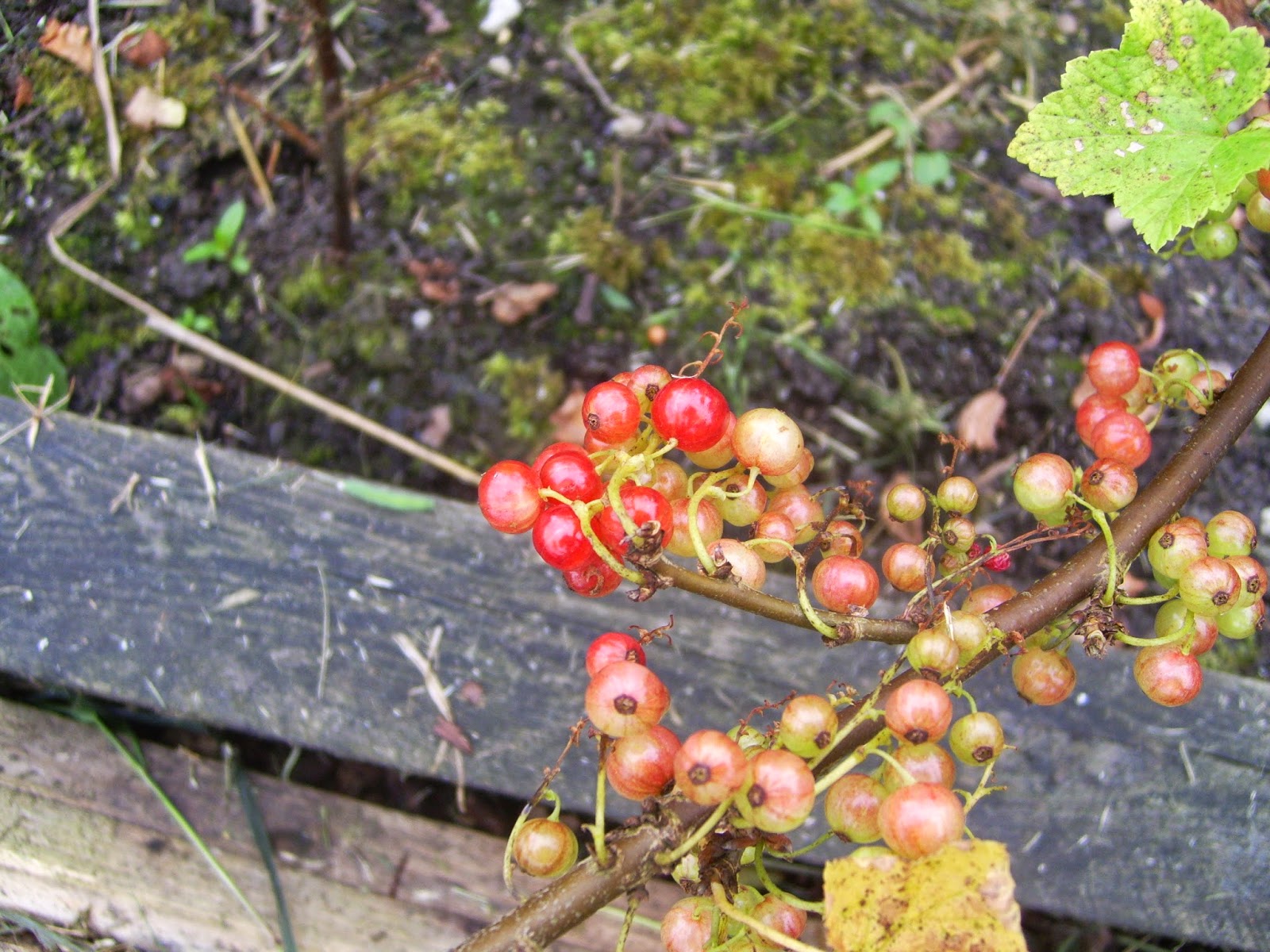
The current and gooseberry bed is looking very lush and green, but the currant plant nearest the camera has absolutely no fruit what so ever!

The leaves are different to the other currants on the plot, so I will have to wait until I get some fruit before I can identify it properly.

Waiting for a space


On my table I have loads of broad beans and peas just waiting for a space to become ready in one of the beds.

There are also a few brassicas that were originally in the poly tunnel but were attacked by a slug.  Hopefully they can recover enough to be planted out.


Cucumbers, Squash, Basil and Chives


On the stand on the decking I have got a few strawberries that were rescued after a communal tidy day a few weeks back.

They have been joined by a few  Crystal Lemon Cucumbers, Hawk Squash, Purple Basil and a pot of Chives.


Add caption


In my original square foot garden bed there are two perpetual spinach and a chard that have gone wild, and are now far too big for the bed.

I will take them out and plant up some new seedlings as they take next to no time to grow and I will try to keep on top of picking the leaves so they don't get out of hand so easily again.


Walking Onion bulbils


My walking onion (Egyptian Tree Onion) is thriving - there are loads of bulbils forming on the top of their leaves, the bulbils, leaves and bulbs are all edible, but I am leaving it to grow as it is a perennial.

Most of the long stems have been broken by something - not sure what but I hope it wasn't me.


This year I have three beds of potatoes in the ground, the varieties I am growing are Maris Peer and Red Duke of York (1st earlies), Cara and Sarpo Mira (2nd earlies) and Pink Fir Apple and Orla (Maincrop).


White Currant


Last year I was given a couple of currant bushes, one red and one white, which I stuck into either end of a bed just to give them a temporary home.

Both bushes have taken, and I am very happy to have them absolutely dripping with fruit.


Red Currant
The redcurrant bush was so large that I had to clip it down quite a lot to get it in the back of the car.

Rather than throw these clippings away I stuck them in the ground around the bush.

Every single one survived and grew on, so I will have loads of redcurrants for my wine making later this year.


Compost pile


Last year I had been using two dalek compost bins, but the amount of green waste I was producing soon filled these and more.

I was fortunate to be given a few pallets by another plotholder which I screwed together to make a compost baywhich as you can see is also nearly full already.


First Signs of Life

After planting up my first leeks and beans just over a week ago I thought I would share their progress.

Broad and Runner Beans - 10 days after sowing
No signs at all from the Runner Bean Sonesta (on the left), but three strong plants from Runner Bean Enorma and eight out of twelve of the Broad Bean Aquadulce are coming through.

These have been kept on my kitchen table which is out of direct sunlight and watered from the bottom.


One thing I have noticed is a couple of very spindly shoots also sprouting alongside the beans, obviously sonething that is coming from the potting compost.

As fast as they come up I have been removing them, but I am a bit disappointed that the compost isn't as sterile as it should be.

I also planted up 48 leeks at the same time as the beans, but so far only one shoot is showing.

A little bit disappointing, but the shoot that is showing looks to be quite a strong one.

If they all come up  like that then they should be soon ready for planting out at the plot.


Sowing the first seeds of 2013

Well, last night I finally took the plunge and sowed my first seeds of 2013.

I had been putting this moment off for some time now for a few reasons.

Firstly, at the moment there is very little room free to put seeds at home as my son and his girlfriend are staying with us until they can find a new house, so we have a lot of their furniture squeezed into every available spare space.

Secondly, although several of my reference books suggest New Year's Day as the prime time for planting leeks, I had concerns that the level of natural light that would be available to any seedlings wouldn't be enough to prevent them going weak and leggy.

As these leeks are being grown as part of a fun online competition I want to make sure to give them the best possible start, so I decided to delay sowing until now in the hope that a later date would give stronger seedlings.


I planted 48 Leek 'Mammoth' into two trays of individual modules.  Once again I strayed from traditional methods which recommends sowing thinly into a tray and only thinning into modules once the seeds are a few inches tall.

I decided to plant direct into modules, one seed per module to give the leeks the best possible chance to develop without any competition for water and nutrients and also no disruption to the root system until I am able to plant them out in their final positions.  The main disadvantage with my chosen method is that if any seeds fail to germinate then I have wasted the space, but there will be nothing to prevent me from sowing another seed in the empty module, so I am hopeful that I have made a good decision here.

I also decided to plant up a few beans, again to try and give them a good start.

I sowed 8 Broad Bean Aquadulce Claudia, 8 Runner Bean Enorma and 4 Runner Bean Sonesta.  All the beans were sowed into individual 2 1/4 inch pots.

I watered them from the bottom by standing them in the sink filled with a couple of inches of water for a few minutes.  Looking at them tonight I noticed that a couple of the Broad Beans had risen to the surface of the compost.  Now it is too soon for them to be germinating and so I pushed them back under the surface.

I would have sowed more but I was limited to space to store them on the kitchen table.

As soon as the weather improves enough I will transfer these trays into the blow away and sow a second batch of leaks plus a few more varieties of beans and peas.