Showing posts with label Bees. Show all posts

'The Bee Hives Are Burning!'

One Sunday night in the middle of February I got the kind of phone call that you dread.

It was about 10.45 and I was just about to go to bed when my mobile rang.

The caller ID said it was our allotment secretary and a fellow beekeeper who said 'There's been an arson attack on the allotment - the bee hives are burning!'


Any tiredness I might have been feeling disappeared and my wife and I jumped into the car and made our way to the allotment. We live about 10 minutes drive from the plot, and so by the time we got there the fire brigade had already put the fire out.


It turned out that of the seven hives on the apiary, six had been doused in some kind of thinners and one had actually been set alight. The firemen thought that this had probably gone up so quickly that it scared the villain away before they could set fire to the rest.

All that is left of the stand
The hive that had been torched was a complete loss - it had been a poly hive with plastic frames and
so there was nothing left of it at all, just a badly charred stand. The plastic hive which had been next to it had partially melted on one side, but was intact. there is no lighting on the allotment, so we had to scour the whole site using head torches and reflected light from the nearby residential flats for any clues.

There were no signs at the usual points of entry - we had previously piled up spikey branches and wet manure directly under the fence corner where kids had gained access to the site before, and these were undisturbed. The only other easy ways into the site were through the main gate, but that is covered by CCTV (later checks showed that no one had come through that way) or through a gate that leads directly onto the allotment from a neighbouring back garden.


This gate is unfortunately right next to the apiary, and could have been used without the neighbour's knowledge.

It is very unlikely that anyone would have come over our wall and walked past three sheds, two poly tunnels and two greenhouses without causing them any damage just to enter the apiary to burn hives, so this gate seems to be the most likely place the arsonist got onto the plot.


Some charred brood cells in the ashes
The next morning I went back to the allotment to inspect the damage in the daylight - the six hives that had been doused belonged to the other two beekeepers on the site, the only one missed was ours, perhaps because it was on the other side of the apiary and had been missed, or possibly the attack had been targeted against the other two beeks?


We were very concerned about the other hives as petrol fumes are often used as the best way of disposing of a diseased colony and we weren't sure how the colonies would fare. I made a quick call to the Regional Bee Inspector to inform him of what had happened, and he advised us not to open the affected hives until Spring as there was nothing we could do - if the queen had been killed we couldn't replace her so early in the season, but if she hadn't then opening up the boxes in the cold was likely to do more harm than good. We spent the next few weeks on tenterhooks, hoping to see some activity to show whether we had thriving colonies but the weather was too bad for the bees to venture out much.

Orientation flights from our Hive
March came, and we had a couple of days of warmer weather, and to our relief there were signs of life from most of the hives. Bees were seen bringing in pollen into two of the doused hives which is a good sign that the queen has been laying as the pollen is used to feed the growing brood. Our own hive was extremely busy with hundreds of new bees taking to the air on their first orientation flights. It does look as though the majority of the colonies in the apiary have survived this cowardly attack, and we still have no evidence that can point us one way or another.

Lots of activity
The local council sent their allotment officer down when they heard what had happened, and when he saw the unofficial gate next to the apiary he wasn't best pleased, and is in the process of getting it blocked up which should help with security. We are also looking at setting up a trail-cam or even wireless CCTV just in case anything else happens.

A week or so after the incident we set up a donation page for the beekeeper who lost both his hives and at least one full colony - we still don't know about the second. I was completely gobsmacked when, against all my expectations, it reached it's goal of £350 within four days, mainly small donations from complete strangers.  If anyone else wants to contribute, additional funds over the target will be used to go towards providing security on the apiary. Help Fund John's Bees

Events like this shake your faith in human nature at first, only to have it renewed even stronger by the generosity of strangers. Thanks to all who sent messages of support, and to those who donated as well. We won't be beaten by this, and will return even stronger.

Big Momma is in the house (hive)

It's inspection time again at the allotment apiary.

The bees are supposed to be inspected at least every nine days to make sure that the colony isn't running out of space and likely to swarm, but due to poor weather this inspection has spilled over onto day 12.

Opening the hive
The fact that this is a new colony from a swarm coupled with it only covering three or four frames on the last inspection meant that we weren't too concerned, but as it was a lovely day yesterday we decided to inspect on the way home from work.

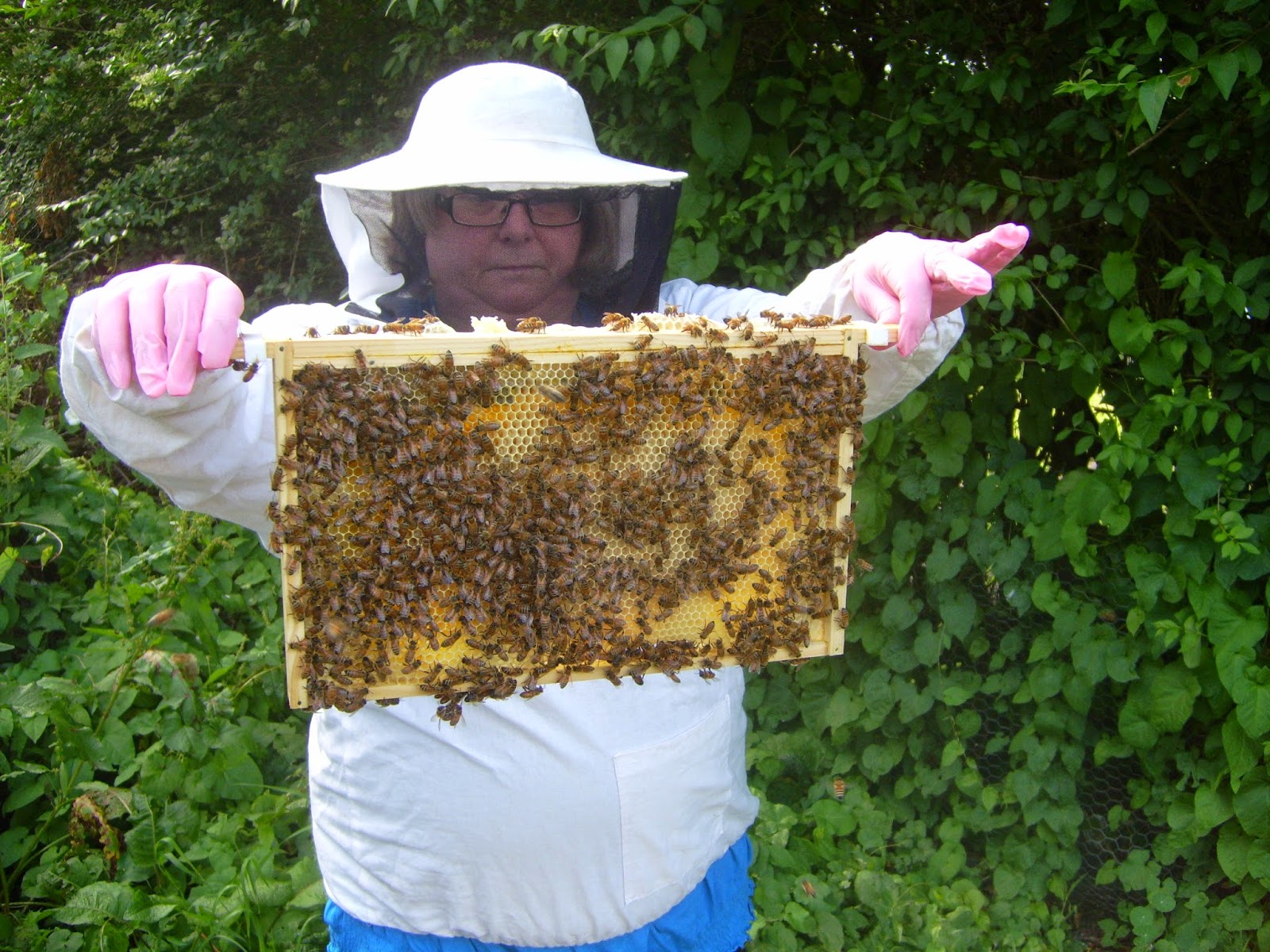
Diane very kindly agreed to help once again, so suited and booted the two ladies opened up the hive and got to work.


On opening the hive it was obvious that there was not major change from last time.

Frame five - lots of bees but no real comb as yet

 
The bees were clustered around frames six through nine as before, but when Angela lifted out frame five there were a lot of bees on it, but only the beginnings of comb.


This is a good sign as it means that they are getting ready to expand.


Frame six
 
I have been watching the bees over the past week every time I have been on the plot, and they have certainly been busy.


We have still got the entrance reducing block in place and sometimes the bees have been queuing up to get into the hive.

Some of the returning bees are obviously carrying loads of pollen as the baskets on their legs are full of bright yellow and white pollens, destined to be used to feed the growing brood.

One of the objectives for today was to try and locate the queen, and Angela spotted her on the outside of frame six.

Close up on the queen - middle of the picture, one third in from the right with no banding
A queen bee is supposed to be about 50% larger than the workers, but this lady was huge - almost double their size, and a lovely pale brown colour.

Frame seven showing lots of activity


She wasn't marked, which means that either she is a new, young queen (which fits with there being no evidence of her laying until day 17) or an old queen from a wild colony, or from a colony that hasn't been looked after properly.


Frame 8
The nearest other colony to home is apparently not being run and inspected properly according to our local Beekeeper's association, so it is possible that this is one of their older queens, but for now we have to assume that she is a new queen and so we will mark her up accordingly.


Marking queens is done for a couple of reasons - firstly, it lets you know how old the queen is as each year a different colour is used - this year is green - and secondly, it makes her much easier to spot when you are scouring the frames to find her.


Unfortunately Diane hadn't brought her queen marking gear out so we had to leave her unmarked for now, but at least we had seen her at last.

Frame nine with loads of mutant comb


The fact that she was on the outside of frame six is hopefully a good sign as the only reason for her to be there is to lay eggs, and she should only be there if the other frames are full.


If she has been laying strongly since she was mated then soon we should start seeing an increase in the colony size.


Workers take 21 days to hatch from being laid, and so assuming that the earliest she started laying was right after the second inspection on day 10 today was the very earliest that we could expect to have new bees.


Italian bees such as we have are supposed to be prolific layers, so hopefully we will see a huge increase in numbers at next weekend's inspection.


A queen can lay up to 2,500 eggs a day, so over seven days we may have a few thousand additional workers to help build the comb for the colony to expand and survive.


Frame ten being replaced
As the bees had not expanded the comb as much as we would have liked to see we decided to give them a final feed of sugar syrup, but only 1/2 a kilo in a litre of water this time.

After this they are on their own.

We have a Queen!

New Brood Box in place
It has been about a week since we did our first inspection of our new beehive.

It is important to check your bees at least every nine days during the summer months to make sure that your colony has enough room, and that they are developing well with no sign of disease or infections.

Last time Angela checked the hive it was very obvious that the spacing of the frames was all wrong as the bees had started to fill in the gaps between the frames with comb, leasing to the strange formations you can see in the pictures from then.


Revealing the colony
When I had got our hive last year it had come with a couple of strips of metal castellations, and so I had decided to fix these inside the brood box as I thought that was where they should go.

I now know that this was a mistake, as it made the spacings too wide.  A National brood box has space for eleven frames, but we only had ten in ours, hence the extra comb.


Moving the frames to the new brood box
Fortunately we already had a spare brood box without castellations, and we also had a handful of plastic spacers that fit over the ends of each frame to make sure that there is just the correct amount of gap.

We needed to transfer the colony from one box to another.

The first thing to do was to put a large piece of cardboard on the stand next to the hive, and to lift the whole brood box off the base and on to the cardboard.

The first of the drawn frames-frame 5


This was to make sure that the queen (if we had one) did not drop off the bottom of the frames and into the grass and get lost.


After that, each frame had to be lifted out of the original box, plastic spacers added to each end and placed into the new box.


Checking for brood


It was important to keep the frames in the same order so this was done very methodically.


Angela started to come across the first drawn comb five frames in, and was soon uncovering the bulk of the colony on the next frames.


Frame seven showing plenty of capped cells

Frames five, six and seven were where the main colony was, and Angela and Diane checked both sides of the frame for evidence that the queen was there, and was viable.


Fortunately there was a good brood pattern with plenty of capped brood which meant that our queen was still alive, and had mated.

Strange comb formation


As a viable queen she had started to lay and our colony looks to be on its way at last.


Frames seven,eight and nine were also quite heavy which indicated that not only did we have brood in the capped cells and pollen in the bright yellow cells, the bees were also storing nectar which would eventually become honey.

A very good sign.


Plenty of activity

It has only been seventeen days since I caught the swarm, and as it takes a minimum of 21 days for a bee to hatch we weren't expecting to see an increase in numbers just yet.


The numbers in the hive don't appear to be much reduced, thankfully, and now that we have seen that the queen is laying we can look forwards to seeing much more comb containing brood, pollen and nectar the next time we inspect.

Diane pointing out a cell filled with nectar


The strange comb formations will need to be dealt with at some point.


We will probably wait until all the brood have hatched before carefully slicing the surplus off and returning the trimmed frame to the hive.


The empty feeder
The bees had managed to eat all of the sugar syrup that we had put out for them on our first inspection which means that they are either very lazy, or that the flow of nectar and pollen coming into the hive is still not up to full speed.

We didn't have any more syrup with us this time so we decided not to feed the colony any more just yet and to wait until our next inspection to see how they have done on their own

Frame nine showing some development


Diane's bees drew out seven or eight frames on one feeding of sugar syrup, but ours have only managed five or six on two feeds.


I have been reading up everything I can find on the internet about Italian bees, and it seems that if you feed them they will prefer to raise brood with syrup rather than build comb.


Brushing the last few bees from the original brood box


This may explain the slow progress across the frames, but also means that we may have a sudden dramatic increase in population inside the hive fairly soon so it will be important to have a second box ready to put on top of the brood box to give the colony room to expand so they don't feel the need to swarm.


Bee Update

Before I get into this post, let me make a promise to all my readers (yes, all two of you! :))

This is not going to become a bee-dominated blog.

I still intend on keeping this a general allotment/veg growing blog, but it's just that at the moment a lot of our time has been spent on the bees, so it is only natural that the blog updates will reflect that.

Preparing to open the hive
 Last night was an important stage in our beekeeping journey as it was the first inspection of the swarm since they had been put in the hive.

We had hoped to do this on day 7, but the weather was against us with heavy rain and even thunderstorms so it wasn't until day 10 that the conditions were good enough to open the box.

Removing the empty feeder
The sugar syrup which we had given them on day 3 was virtually all gone which was a good first sign that we should see some decent comb production.


First sight of the bees

The crown board was lifted and put to one side and we got our first sighting of the bees.

They had clustered around frames 3, 4 and 5 and looked quite busy.

Starting the inspection
 The inspection had three aims.

Firstly to make sure that the bees were still in the hive and were making comb.

Additional comb made due to wonky foundation
It was obvious from the first frame that Angela lifted that comb was being made.  The large lump of comb you can see on the picture above, and what you will see on subsequent pictures is not a problem with the bees but a problem with the bee keepers.

The frames we used had been stored over winter and had also been bashed around a bit when we had tried to catch a swarm the previous year, and as a result the wax foundation which the bees use to build the comb upon was no longer straight.

Bees will fill any space bigger than 6-9mm with comb, so all they are doing is correcting our mistake.

Checking for stores
 The second goal of the inspection was to check that the bees were laying down stores of pollen and nectar.

Several of the cells had been filled with a reddish pollen, but there wasn't much evidence of nectar as yet, but as this was a very new swarm it's not too much of a concern at the moment.

Looking for the Queen
 The third and most important part of the inspection was to look for evidence of the Queen.

More strange comb
 We were looking for signs that the Queen was laying eggs, but if we managed to see her as well that would have been a bonus.

Still no sign of the queen
Unfortunately we didn't spot her, nor could we see any evidence of her laying eggs in any of the empty cells.

Although this was a bit of a set back there could be a few explanations - the Queen could be a virgin Queen who has yet to be mated - as long as she rises to mate before she is 41 days old there will be no problems, and as we have only had the swarm for 10 days we have about 3-4 weeks of that timescale left.

The Queen might be laying on the underside of some of the strange comb formations.

We might have accidentally killed the Queen during the capture of the swarm, or she may have died during the last week.

This is the worst case, but the bees were so docile during the inspection that we felt this to be unlikely.

If we did have no Queen we would then be reliant upon Diane having a spare frame from one of her hives which had brood on.

This frame would be put into our hive, and the workers, recognising that there was no queen present, would select one of the developing brood and extend the cell to make it a queen cell and create their own new Queen.
Adding more syrup
At this point there was no need to keep the hive open any longer so the feeder was put back on top and the bees were given another feed of sugar syrup.

This should be the last time we will need to feed them as they have started to forage for themselves so should now become self sufficient.

We will inspect the hive again this weekend to see if there is any change, and hopefully we will start to see some brood cells which will indicate that the Queen is present and laying.

I'm back!!


Wow.

Has it really been a whole year since I updated this blog?

Apologies for that, but life has become an awful lot busier as I became a Grandad which has taken up so much more time than I could have ever imagined that it would.

Anyway, back to business.

I still have my allotment, and it is slowly being brought back under control after being mostly neglected over the winter, there are crops in the ground and lots of seedlings in the polytunnel, and quite a few new beds as well.

I will do a much more detailed update later, I am writing this update now because we have finally managed to get some livestock - about 10,000 of them.

Yes, we are now keeping bees!

Angela and Diane about to inspect the hive

My wife Angela has been very interested in keeping bees from the first day we arrived on the allotment and discovered that there was one area set aside for an Apiary.

Towards the middle of last year we purchased a hive and other necessary bits from Ebay but were unable to get a swarm, despite us leaving the empty hive at my local church which had several bee colonies living in the walls.

This year we decided that trying to catch a swarm was too random an event, so I contacted a local beekeeper who sells bees to get us on her list for a nuc (a nucleus of bees including a queen, some frames of brood and stores of food)

Two weeks ago Diane, a friend who already has bees at the allotment, offered us a some bees as she had no room for them herself.

We weren't able to get down to the plot so she put them into our hive for us, but unfortunately they decided not to stay and left later the same day.

Last weekend started off as usual with me on the plot early on Saturday and all seemed normal until I strolled over to have a chat with a newly arrived plot neighbour.

As I got to him, Jimmy said 'I think we may have a bee problem' and pointed over towards Diane's shed where I could see loads of bees circling around.

I went to have a look, and could see loads of bees being very interested in a bait box (small empty box used to encourage swarms to take up residence) that Diane had left out balances on top of her compost heap.  It was a wild swarm that had decided that her box was where they wanted to be!

The bait box


I gave Diane a quick call, and as she lives next to the allotment she was soon on to watch the spectacle.  Within five minutes all the bees had gone inside the box, and she offered the swarm to us.

I eagerly accepted, and we agreed that we would return towards dusk to transfer the bees to our hive as we felt that the previous swarm had been transferred too early in the day which had given them enough time to re-swarm before night time.

We hadn't been home for long when Diane called me to say that she had just caught another swarm which was larger, and would I like that one instead?  Her brother in law had come down to see the first swarm, and on his way home had walked past a lot of bees in a nearby alleyway which Diane had also managed to catch in a large cardboard box


Wild Swarm
Wild Swarm

At 8pm on Saturday Angela and Diane, suitably dressed in beekeeping smocks and veils, emptied the box of bees into our hive.  All went well, and we watched the last of the bees join the queen inside as the sun went down.
Our hive at the back with bees in the blue parcel


Opening the package


The next morning was warm and sunny, and we went down to the allotment to check on the bees around 9.30am before we went out for the morning.

There was no sign of activity as we approached the hive, but as we got closer there was a definite loud buzzing sound coming from within, so we went away happy.
Tipping them in
The happiness was not to last, however,  as we had a text from Diane at about 12.30pm to say that the bees had swarmed again and we had an empty hive once more.

Later that afternoon we were sitting in our front garden with our grandson when I started to hear some loud buzzing, which I though was coming from a 40' sycamore at the bottom of the garden, but Angela pointed out what looked like a drifting cloud of smoke coming up the road towards us.

Unbelievably, it was another swarm!

Some needed a little encouragement to leave the box!

It flew right over our heads and eventually settled about 11' up in a neighbour's conifer hedge, two houses away.

Even though I had never done it before, I decided that I was going to catch this swarm myself.

After getting some advice from Diane I armed myself with a rickety pair of small steps, a pair of loppers, a cardboard box and an old shower curtain.
Finally in their new home
I put on Angela's bee smock and veil, placed the shower curtain on the ground under the hive, put the box on top and climbed the steps.  Now, these steps were only 3' high, I am 6' and so the bees were still 2-3' above my head, so I reached in with the loppers and blindly started to cut the branches that the swarm were sitting on.

The first small branch fell and missed the box completely so I jumped down and scooped up the bees and put them in the box.
Stragglers entering the hive

The second branch that I managed to cut was much larger, with loads more bees on it but unfortunately the additional weight caused it to swivel as it fell, and it landed straight on top of my head.

For a second or two my veil was completely covered in bees, but I carefully climbed down and brushed most of them off and into the box.

By this point there were quite a lot of bees flying around, so I moved a few feet away to watch to see if there was any indication that I had got the queen in the box already.
Note the bees in the entrance fanning to send the 'this is home'  pheromone to bring in the last few still outside

If I had caught the queen the rest of the bees would follow her scent and also join her in the box.

It took a couple more attempts up those rickety ladders before she was finally in the box, but about an hour after the first attempt almost all the bees were safely inside and I was able to secure the lid closed with some tape, wrap the box in the shower curtain to catch some of the bees that hadn't gone inside and move the whole thing into the shade to let them settle.

At 8pm on Sunday Angela and Diane repeated the process of tipping the swarm from the box into the empty hive, but this time we decided to trap the queen inside for a couple of days to prevent them from re-swarming again.  This was done by putting the queen excluder on the bottom of the hive - this allows the workers to pass through but not the larger queen.
The third swarm entering the box

This swarm was the largest of the three we had tried to house, and the bees were a very light brown and yellow which probably means that they are descended from and Italian strain of bees.

 
Securing the hive
To make sure that the bees had enough supplies to get them properly started off we decided to give them a feed of sugar syrup, so after they had had a couple of days to get used to their new hive we added a feeder to the box.

Feeder in place

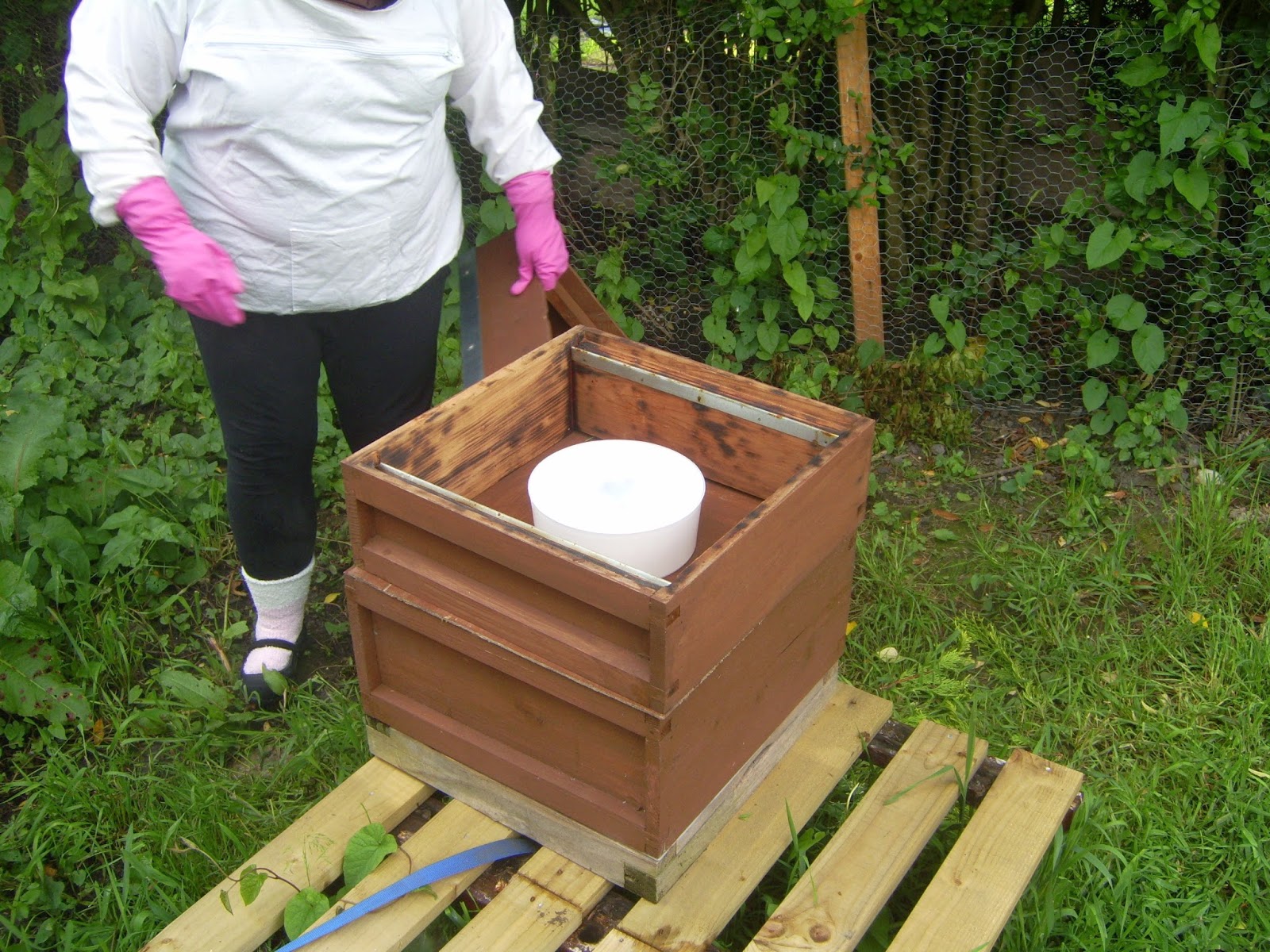
The feeder we used is like a plastic dougnnut with a small central hole to allow the bees to enter the feeder, but with a cup covering the hole to stop them entering the super that the feeder is housed in.


I mixed 1kg of sugar with 1 liter of warm water and poured it into a plastic feeder

Lid removed so you can see the bees feeding


On Thursday night we decided that we now needed to remove the queen excluder from the base of the hive. 

Feeder removed
Although this will allow the queen to leave the hive and possibly take all the bees with her in a swarm, it is important to do just in case we have a virgin, unmated queen because if she does not fly to mate before she is 41 days old she never will. 

Excluder out

This would be disastrous as she would then not be able to lay any eggs and the hive would slowly die out.

Replacing the feeder
 We were anticipating the worst case scenario in that there would be loads of bees sat on the excluder, but in the end there were only a couple, and by placing the excluder in front of the entrance they soon climbed back in.

The stragglers going home
We also took the opportunity to slide out the baseboard which sits under the mesh floor and give it a basic inspection,  There were a small number of dead bees who must have tried to enter the hive the wrong way, but there was also a large amount of small wax scales which shows that the worker bees are hard at work in building up the comb inside the hive.

Wax scales on the baseboard